
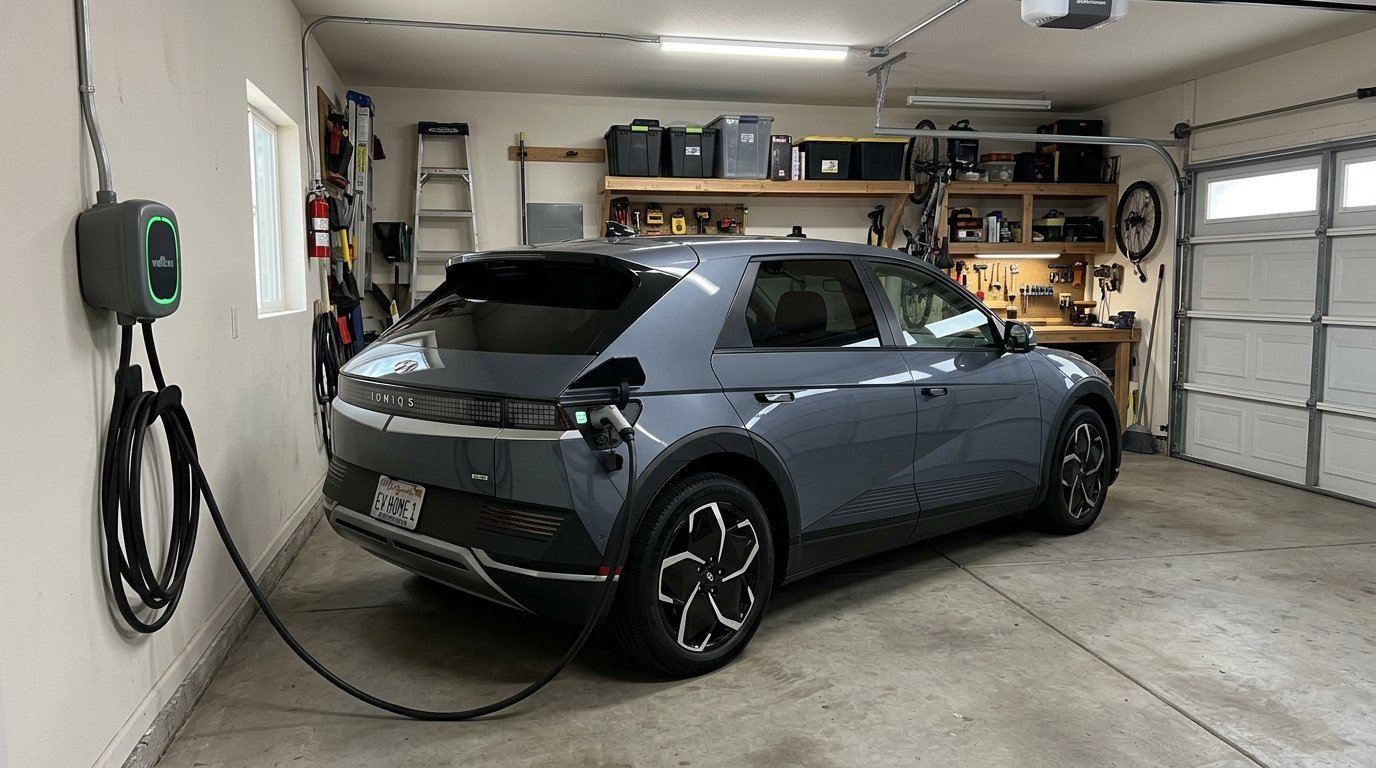
Owning a Hyundai electric vehicle — whether it’s the Ioniq 5, Ioniq 6, the new Ioniq 9, or a plug-in hybrid like the Tucson PHEV — is one of the best decisions you can make in 2026. But to truly experience the convenience of EV ownership, you need a Level 2 home charger.
Charging with a standard 120V outlet (Level 1) adds only 3–5 miles of range per hour. A Level 2 charger, running on a 240V circuit, can deliver 20 to 35 miles of range per hour — meaning most Hyundai EVs can be fully charged overnight, every night.
This complete Hyundai EV Level 2 charger installation guide for 2026 walks you through everything: what equipment you need, how to find a licensed electrician, permit requirements, expected costs, and which EVSE brands work best with your Hyundai model.
📋 Table of Contents
- Why Level 2 Charging for Your Hyundai EV?
- Compatible Hyundai EV Models (2026)
- What You Need Before Installation
- Best Level 2 Chargers for Hyundai EVs
- Step-by-Step Installation Process
- Cost Breakdown: Level 2 Charger Installation USA
- Permits and Electrical Requirements
- Federal Tax Credits & Rebates (2026)
- Finding Public Level 2 Chargers
- Frequently Asked Questions
1. Hyundai EV Level 2 Charger Installation Guide 2026
Level 2 charging uses a 240-volt, 30–60 amp dedicated circuit — the same type of circuit used by electric dryers or ovens. This delivers significantly more power than a standard wall outlet, translating to dramatically faster charging speeds.
| Charging Level | Voltage | Amps | kW Delivered | Miles/Hour |
|---|---|---|---|---|
| Level 1 (standard outlet) | 120V | 12A | ~1.4 kW | 3–5 miles |
| Level 2 (home/public) | 240V | 32–48A | 7.2–11.5 kW | 20–35 miles |
| DC Fast Charging (public) | 400–800V | High | 50–350 kW | 100–300 miles |
2. Compatible Hyundai EV Models (2026)
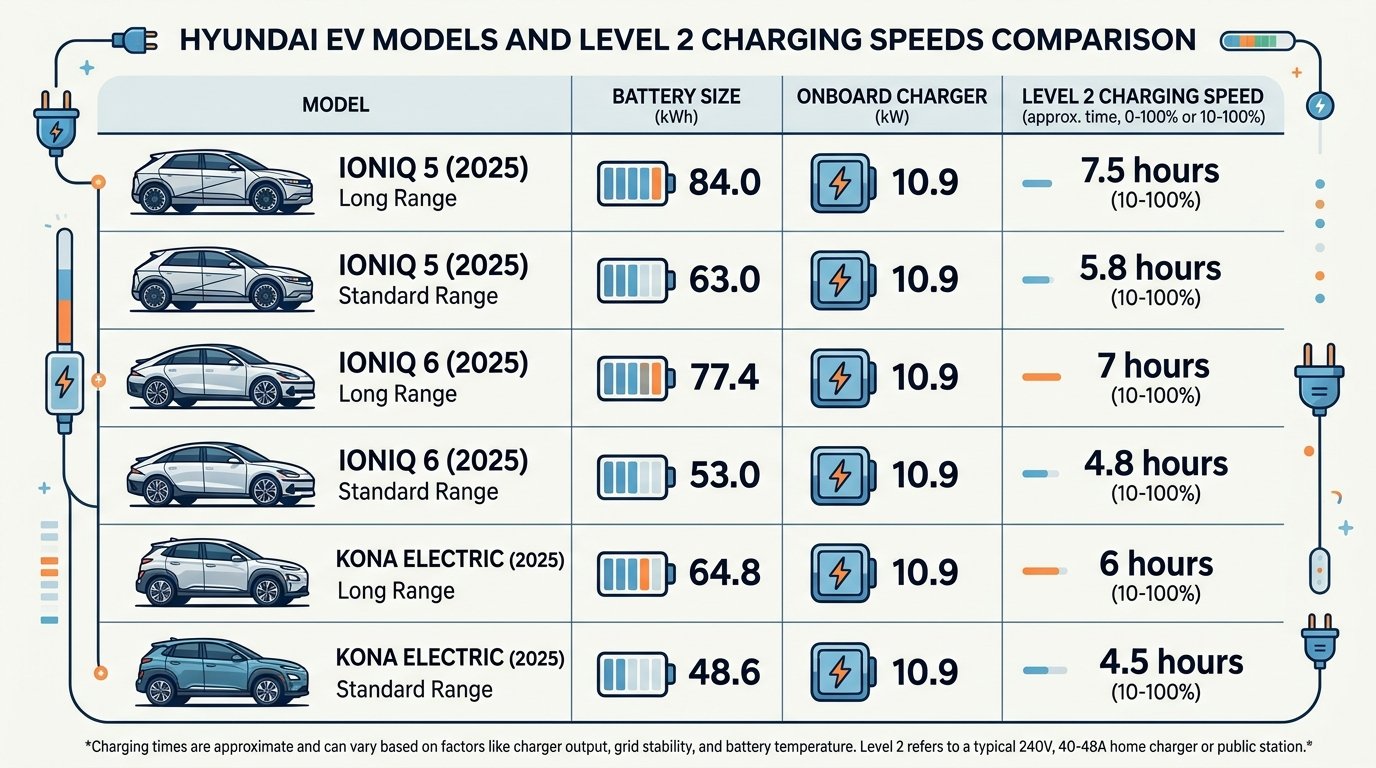
All current Hyundai EVs and PHEVs use the standard SAE J1772 connector for Level 2 AC charging. This means any certified Level 2 EVSE available in the USA will be plug-and-play compatible.
| Model | Type | Onboard AC Charger | Estimated Full Charge (Level 2) |
|---|---|---|---|
| Ioniq 5 (Standard Range) | BEV | 7.2 kW | ~7–8 hours |
| Ioniq 5 (Long Range AWD) | BEV | 11 kW | ~8–9 hours |
| Ioniq 6 (RWD) | BEV | 11 kW | ~6–7 hours |
| Ioniq 6 (AWD) | BEV | 11 kW | ~8 hours |
| Ioniq 9 | BEV | 11 kW | ~9–10 hours |
| Tucson PHEV | PHEV | 3.3 kW | ~2–3 hours |
| Santa Fe PHEV | PHEV | 3.3 kW | ~2–3 hours |
3. What You Need Before Installation
Before an electrician arrives at your home, you’ll want to assess and prepare a few key things:
Electrical Panel Capacity
A Level 2 charger requires a dedicated 240V circuit. Your electrical panel must have enough spare capacity to support a 40–60 amp breaker. Most modern homes (200-amp panels) can accommodate this without an upgrade, but older homes with 100-amp panels may need a panel upgrade first.
Distance from Panel to Garage
The further your electrical panel is from your planned EVSE location, the higher the wire installation cost. Conduit runs over 50 feet can significantly add to labor costs. Ideally, install your charger on the wall closest to your panel.
Garage vs. Outdoor Installation
While indoor garage installation is most common, outdoor EVSE units (NEMA 4 or NEMA 14-50 outlet with appropriate weatherproofing) are also viable if your vehicle parks in a driveway or carport.
4. Best Level 2 Chargers for Hyundai EVs (2026)
All of the EVSE units below use the standard J1772 connector and are UL-listed and compatible with every Hyundai EV and PHEV model.
5. Step-by-Step Installation Process
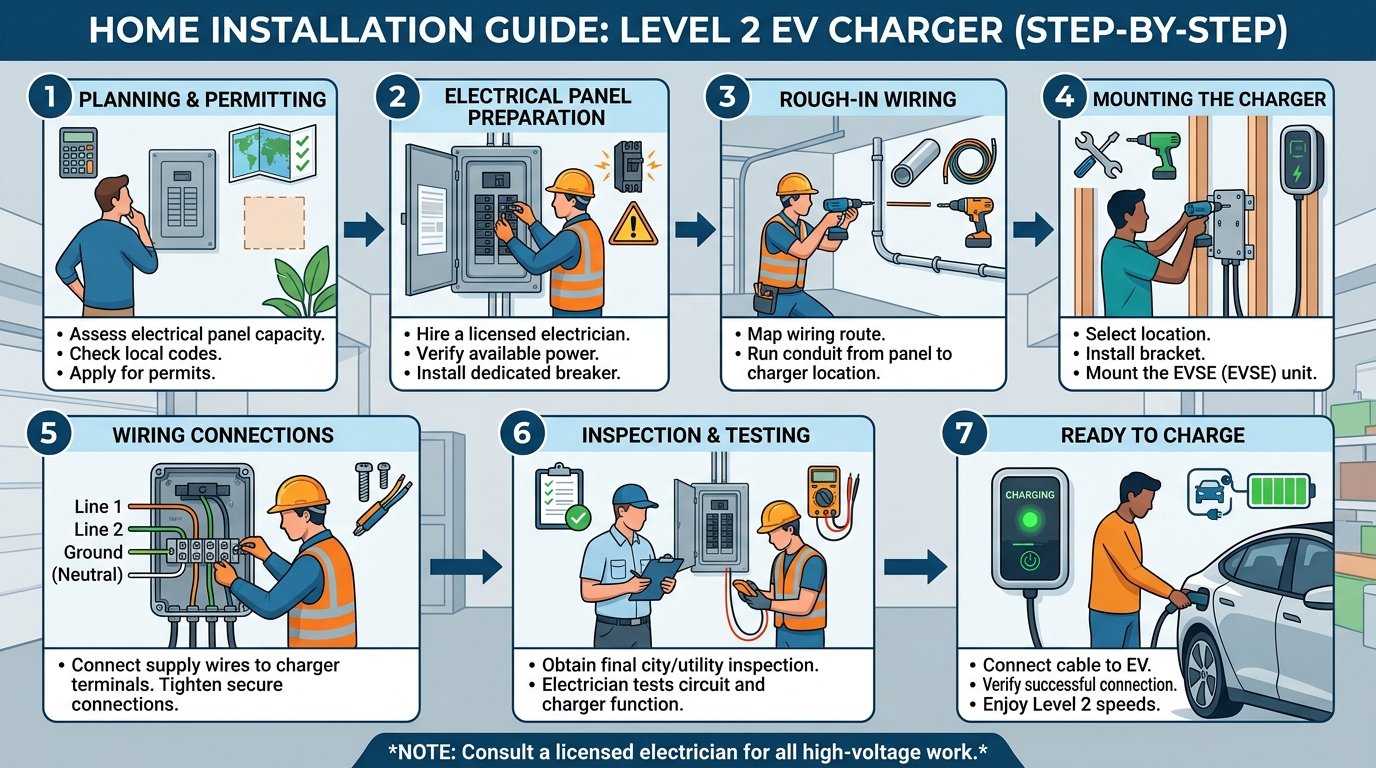
Here is the complete process from purchase to your first full charge:
- Assess Your Electrical Panel Check if your home’s electrical panel has enough capacity (at least 40–60 amps free) for a dedicated EV circuit. Look for open breaker slots and check the panel’s total amperage rating (100A, 150A, or 200A).
- Choose Your EVSE and Location Select your Level 2 charger (see recommendations above) and decide on the installation location — ideally the garage wall closest to your electrical panel to minimize wire run length.
- Get Multiple Electrician Quotes Contact 2–3 licensed electricians in your area. Request itemized quotes covering: circuit wiring, breaker installation, EVSE mounting, conduit, and permit fees. Verify they have experience with EV charger installations.
- Pull the Required Permits Your electrician should handle permit applications with your local building department. Most jurisdictions require an electrical permit and inspection for 240V circuit work. This step is non-negotiable — unpermitted work can cause issues with home insurance and resale.
- Installation Day (2–4 Hours) Your electrician will: install a dedicated 240V circuit from your panel, run conduit and wiring to the installation location, mount the EVSE to the wall, make all electrical connections, and label the new breaker.
- Electrical Inspection A city/county inspector will verify the work meets local electrical codes (typically NEC 2023 or local amendments). The electrician usually schedules this and may need to be present.
- Activate & Configure Your Charger Download the EVSE manufacturer’s app (ChargePoint, Emporia, Wallbox, etc.), connect to WiFi, set up scheduled charging to take advantage of off-peak electricity rates, and plug in your Hyundai EV for the first charge.
6. Cost Breakdown: Level 2 Charger Installation USA (2026)
Total costs vary based on your home’s existing electrical setup, local labor rates, and the EVSE unit you choose. Here’s a realistic breakdown:
7. Permits and Electrical Requirements (USA)
Most U.S. states follow the National Electrical Code (NEC), specifically Article 625, which governs EV charging equipment. Key requirements include:
- Dedicated circuit: The EVSE must be on its own circuit — no sharing with other appliances.
- Circuit sizing: The NEC requires the circuit to be rated at 125% of the EVSE’s continuous load. A 48-amp EVSE requires a 60-amp breaker and 60-amp rated wire.
- GFCI protection: Required for outdoor and garage-adjacent installations.
- UL listing: Your EVSE must be UL-listed (or equivalent). All reputable brands sold in the USA meet this requirement.
- Local amendments: California, New York, and other states may have additional requirements — your electrician will know these.
8. Federal Tax Credits & Rebates (2026)
Installing a Level 2 charger in 2026 may qualify you for significant financial incentives:
- Federal 30C Tax Credit: 30% of equipment + installation cost, up to $1,000 for residential installations. Must be installed at your primary or secondary residence. Claim on IRS Form 8911.
- Utility Rebates: Many utilities offer $100–$500 rebates for EVSE installation. Check your local utility’s website or the PlugShare utility rebate directory.
- State Incentives: Colorado, California, New York, Maryland, and others offer additional state-level EV infrastructure credits.
- EVSE Manufacturer Rebates: ChargePoint, Emporia, and Wallbox frequently offer limited-time installation bundles.
9. Finding Public Level 2 Chargers for Your Hyundai EV
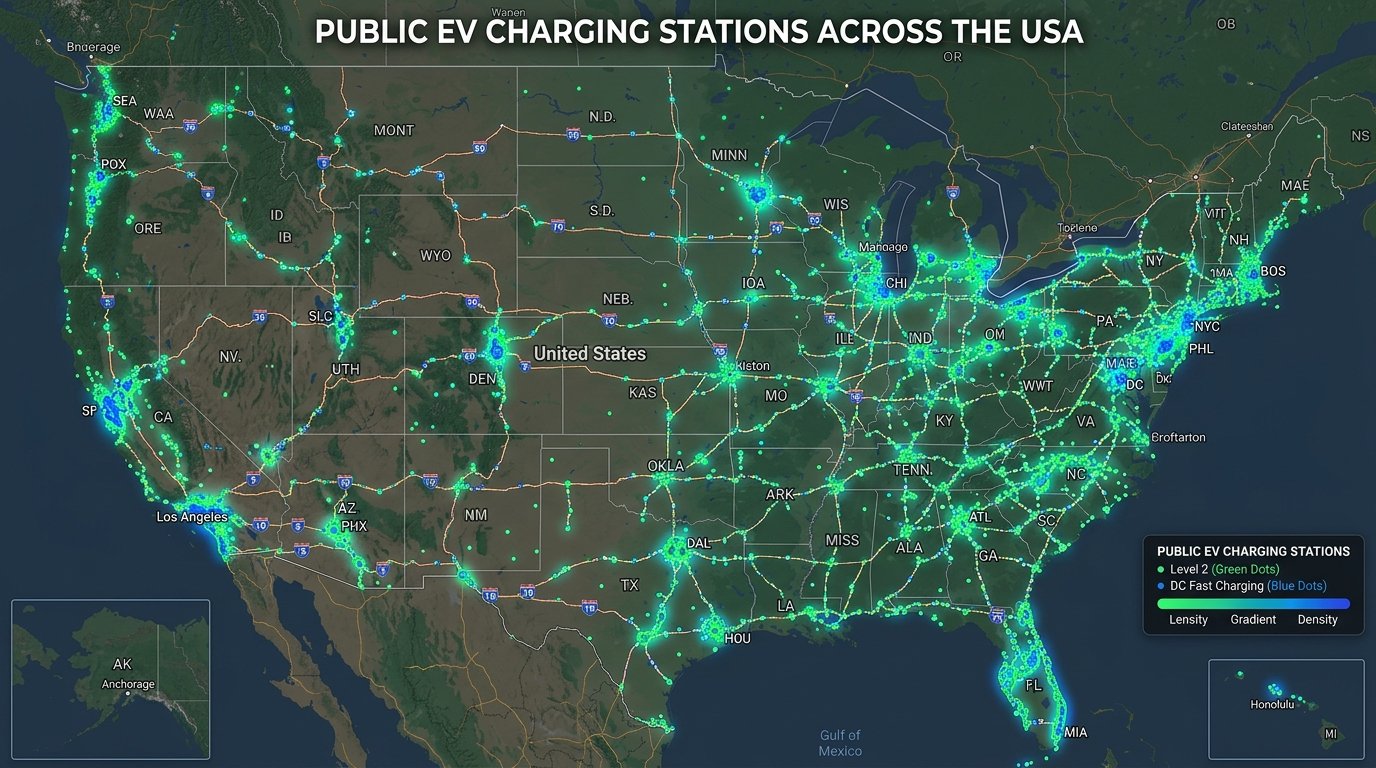
Home charging covers your daily routine, but for longer trips or top-ups away from home, knowing where to find public Level 2 chargers is essential.
PlugShare’s map covers over 1 million charging ports across the USA and lets you filter by connector type, charging speed, network, and amenities nearby. You can also check in and see real-time status reports from other EV drivers.
10. Frequently Asked Questions
-
❓How long does it take to install a Level 2 charger for a Hyundai EV?A professional Level 2 charger installation typically takes 2 to 4 hours on installation day. Factor in 1–3 weeks for the permit approval process, depending on your local building department. The full process from hiring an electrician to your first charge usually takes 2–4 weeks.
-
❓What amperage do I need for a Hyundai Ioniq 5 Level 2 charger?The Hyundai Ioniq 5 (Long Range, AWD) supports up to 11 kW onboard AC charging. To maximize this, install a 48-amp EVSE on a 60-amp dedicated circuit. This delivers ~11.5 kW, fully utilizing the car’s onboard charger. Standard Range Ioniq 5 (7.2 kW) can use a 32-amp unit, though a 48-amp future-proofs your setup.
-
❓How much does it cost to install a Level 2 charger for a Hyundai EV in the USA?Total installation costs in the USA typically range from $500 to $2,000, including the EVSE unit ($200–$800) and electrician labor ($200–$600) plus permit fees. If your electrical panel needs upgrading, add another $1,000–$3,500. After the 30C federal tax credit (up to $1,000), most homeowners pay $400–$1,200 net.
-
❓Do I need a permit to install a Level 2 EV charger at home?Yes, in virtually every U.S. jurisdiction. An electrical permit is required for any new 240V circuit installation. Your licensed electrician should handle the permit application. Skipping this step is illegal, can void homeowner’s insurance, and may create problems when selling your home.
-
❓Which Level 2 chargers are compatible with Hyundai EVs?All current Hyundai EVs use the SAE J1772 connector for Level 2 AC charging. This is the universal standard in North America, meaning any UL-listed J1772 EVSE — ChargePoint, Emporia, Wallbox, Grizzl-E, JuiceBox, and many more — is plug-and-play compatible with your Hyundai.
-
❓Can I use a NEMA 14-50 outlet instead of hardwiring?Yes! Many EVSE units (ChargePoint Home Flex, Emporia, JuiceBox) offer both plug-in (NEMA 14-50) and hardwired versions. A NEMA 14-50 outlet installation is slightly less expensive and allows you to take the charger with you when you move. Hardwired installs are more secure and often preferred by electricians for permanent home setups.
-
❓Does Hyundai offer its own home charger?Hyundai partners with ChargePoint for home charging bundles in the USA. Many Hyundai EV purchase packages include a discounted or free ChargePoint Home Flex EVSE with installation credit. Ask your Hyundai dealer about current home charging offers at time of purchase.
-
❓Will a Level 2 charger work with future Hyundai EVs?Yes. The J1772 connector is the North American standard for Level 2 AC charging and will remain compatible with all Hyundai EVs for the foreseeable future. Even as NACS (Tesla-style connectors) becomes more common for DC fast charging, Level 2 J1772 compatibility is maintained through adapters. Your EVSE investment is future-proof.
Conclusion
Installing a Level 2 charger for your Hyundai EV in 2026 is one of the most practical and cost-effective upgrades you can make as an electric vehicle owner. With overnight charging delivering a full battery every morning, you’ll eliminate range anxiety and reduce dependency on public charging for your daily drives.
The process — assessing your panel, selecting the right EVSE, hiring a licensed electrician, and pulling permits — is straightforward when approached with the right information. Most homeowners complete the entire process within 2–4 weeks and recover a significant portion of their costs through the federal 30C tax credit and utility rebates.
Whether you drive an Ioniq 5, Ioniq 6, Ioniq 9, Tucson PHEV, or Santa Fe PHEV, a Level 2 home charger transforms your ownership experience. Use ChargeStationMap.com to explore charging stations and PlugShare for real-time public charger availability across the USA.